


2026
Good, Evil, Both, or Neither?
View Online

Sign up for a six month free
trial of The Stand Magazine!
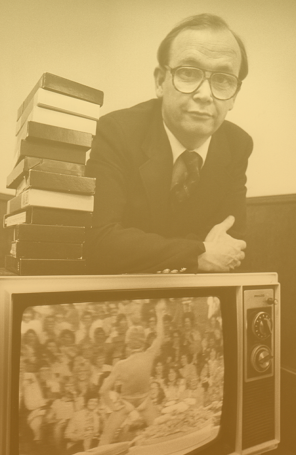
In the early 1980s, American Family Association (AFA)Founder Don Wildmon recognized the dangerous impact pornography was having on morality, family, and society. At the time, few Christians were aware of or acknowledged this issue; even fewer were willing to confront it. Wildmon, however, stepped out onto the front line to combat the problem head-on. Today, that battle continues, and Christians still need to address the danger of pornography – even with young children.
Starting a movement
In October 1982, Wildmon initiated Pornography Awareness Week (PAW), a national campaign to protest the sale of explicit media. In 1983, PAW gained public attention when Wildmon tied it to organized protests held outside the Southland Corporation headquarters in Dallas, Texas. Southland was the parent company of 7-Eleven stores at the time. The 7-Eleven chain later became the subject of a National Federation for Decency (NFD) picketing campaign because of its sale of pornographic materials. (See The Stand 3/24.)
Wildmon detailed his arguments against pornography in his 1986 book titled The Case Against Pornography, and in June 1988, he published a special edition of the AFA Journal titled “A Guide to What One Person Can Do About Pornography.” In the introduction to that guide, he spoke very clearly about the issues at stake:
We can win the war against pornography, but it will not be easy. Pornography is an 8 billion dollar a year business, thus it has many allies. Many of them are in positions of great influence. The greatest ally which pornography has is the silence of the Christian community. However, this is a battle we simply cannot afford to lose. One is wrong to think that the battle against pornography is simply a struggle against dirty words and dirty pictures. It is not. It is a struggle for the very soul of man.
Acting on the legacy
As loudly as his words, Wildmon’s actions demonstrated what can be done to fight against pornography, and as his work gained traction throughout the 1980s, PAW and the ongoing war against pornography’s destructive influences became cemented as a permanent and central focus of AFA’s mission to preserve and protect decency, family values, and the Christian foundations of American culture.
The necessity for diligent action against pornography remains just as real today and, sadly, has become even more subversively engrained in technology. The need for Christians to speak actively and preemptively against any foothold of pornography in daily life is even greater, and yet, many Christians are still hesitant, embarrassed, or uncertain how to address it.
The words of Wildmon from the 1988 guide are relevant still when it comes to the continuing need to take an active and vocal stand against pornography:
The silence and apathy of the Christian community toward pornography must end. We simply must become educated and involved in this struggle. We must speak out. Our society has suffered too much already because of our silence.
Expanding danger
Today, our society continues to suffer from silence on the issue, and because of widespread, easily accessible technology, even children can be casualties.
Chris McKenna, founder and CEO of Protect Young Eyes (protectyoungeyes.com), points out that children will be unprepared if parents hesitate to bring up the subject, and vulnerable if they stumble onto pornographic content that could come at them at any time, from any direction.
“We live in a world where access to traumatizing content is not always under our control,” McKenna told The Stand. “There used to be a childhood – the one that I remember – where the ways in which you could access information that was mature or adult were limited. If you didn't let your kid hang out at a certain house or have access to Showtime or go to that section of the video and DVD store or the bookstore, then you could be pretty successful in preventing exposure to that information.
“We don't live in that world anymore, because of the streaming of music and video and book content,” he continued. “There are 100 different doorways now that we don't control through digital access points. So, that means there's greater risk that childhood will be exposed to those items, which means we must do a greater number of things to mitigate that risk through relational and technical solutions.”
McKenna understands the harm of pornography on a personal level, having struggled with it in his early adulthood. And he is well aware of the risks of digital access for children after working as a risk advisor in the business world for 12 years and for an anti-pornography filtering company for seven years.
But it was the time he spent between 2009 and 2016 in full-time ministry as a youth pastor at Cornerstone Church in Caledonia, Michigan, that made him most attentive to the dangers presented to children with easy access to online content. During that time, he launched Protect Young Eyes to help families, schools, and churches create safer digital spaces for kids.
“In about 2012, we started to hand out iPhones to kids,” he said. “I watched us as a society put technology into the pockets of children during that time. With my background as a risk consultant for large companies, that felt like a really risky decision during a very developmentally fragile time in young people's lives.”
Ending the silence
With the many ways that children might stumble across pornography unintentionally, McKenna stresses the importance of open, honest, and early conversations to forewarn and establish an action plan for children. In a blog post titled “10 Before 10. Making Porn a Normal Talk” on protectyoungeyes.com, he encourages parents to address the issue with their children before age 10 in a sensitive and age-appropriate manner:
You can do this! What about striving for 10 solid conversations about pornography before each of your kids hits age 10? Sure, more might be better, but just to give everyone a start. And, start early! Age 5 if you can. This ensures that your ideas about pornography are embedded in them long before that first exposure.
“The risk is always that parents
shy away from difficult digital
decisions,” McKenna told The Stand. “Yet at the same time we put algorithms in kids’ pockets that are constantly peppering our children. ‘10 Before 10’ is the idea: Let’s have 10 conversations related to pornography. It doesn’t have to always be using the word pornography but is related to equipping our kids to handle a pornified digital world so that we’re not waiting until after they’re exposed to something. We want parents to lead with those … [interspersed] conversations.”
Sign up for free to receive notable blogs delivered to your email weekly.

Sign up for a free six-month trial of
The Stand Magazine!

OUR FAMILY OF MINISTRIES